
The Ultimate Friendly Guide to Your Neck, Desk Strain, and Easy Resets
In today’s work-from-anywhere world, your neck—known in the medical world as the Cervical Region—is probably working harder than any other part of your body. While it gracefully carries your roughly 5 kg (11 lbs) head around all day, long hours at a desk can turn this flexible bridge into a massive bottleneck of stiffness and pain.
The good news? Taking care of your neck doesn’t require a medical degree or hours of intense training. Understanding how your neck works and using a few quick “Easy Resets” is all it takes to keep your daily wellness on track!
Part 1: Meet Your Neck! A Super Friendly Tour of Your Anatomy
Think of your neck as a masterpiece of custom engineering. To keep things simple and approachable, we’ve broken down your neck’s complex internal map into three easy-to-understand teams:
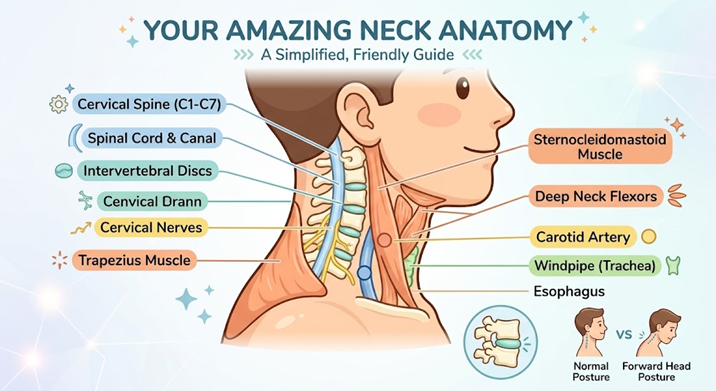
1. The Shock-Absorbing Backbone (Bones & Discs)
- Cervical Spine (C1-C7): Your neck relies on a stack of 7 small bones called vertebrae. The top two—the Atlas (C1) and Axis (C2)—are the real MVPs, letting you nod “yes” and shake your head “no” with ease.
- Intervertebral Discs: Imagine these as tiny, squishy gel pads sitting between each bone. They act as essential shock absorbers so your spine can twist and flex without grinding.
2. The Power Players (Muscles & Stabilizers)
- Primary Movers: The broad Trapezius Muscle runs down your upper back and shoulders (the one that tightens up when you’re stressed!), while the Sternocleidomastoid Muscle lets you turn your head side-to-side.
- Deep Stabilizers: Hidden beneath the surface are smaller muscles like the Levator Scapulae and Deep Neck Flexors. They work like guy-wires on a tent pole, keeping your head perfectly balanced.
3. The Superhighways (Nerves & Arteries)
- Spinal Cord & Cervical Nerves: Passing safely through the middle of your neck bones is the spinal cord, branching off into vital yellow nerve pathways that control feeling and movement in your arms and hands.
- Carotid Artery: This major pipeline delivers fresh blood and oxygen straight to your brain, keeping you sharp and focused.
Part 2: What’s Dragging You Down? The 3 Major “Desk Neck” Traps
Why does your neck feel like a rock by 3 PM? Pain usually happens when our daily habits force this amazing system out of alignment. Here are the three most common traps:
Trap 1: The “Text Neck” Gravity Tax
When you tilt your head forward to look at a laptop or phone, gravity kicks in. At a 60-degree angle, your 5 kg head suddenly feels like a 30 kg (60 lb) bowling ball to your spine!
- Your Deep Neck Flexors in the front get stretched out and fall asleep.
- Your Trapezius in the back has to pull overtime just to keep your head from falling off, leading to that burning shoulder ache and tension headaches.
Trap 2: The “Frozen Posture” Penalty
Even if you have the world’s most expensive ergonomic chair, staying frozen in one spot starves your muscles of fresh blood flow. Microscopic tightness builds up, leaving you feeling stiff and locked in place.
- Screen too low? You’re constantly craning forward.
- Armrests too far? Your Levator Scapulae has to do heavy lifting all day to hold your shoulders up.
Trap 3: The Secret Stress “Shrug”
Ever notice where your shoulders are when an urgent email pops up? When we experience mental strain or anxiety, our bodies enter a subtle “fight-or-flight” mode. We sub-consciously hitch our shoulders up toward our ears, locking the Trapezius into a constant, tiring contraction.
Part 3: Feel Better in 60 Seconds: Your “Easy Resets” Routine
Fixing neck strain doesn’t mean stopping your workday for an hour. These 3 ultra-simple, workplace-friendly Micro-Resets can be done right in your office chair:
Reset 1: Wake Up Your Neck! (The Seated Chin Tuck)
- How to do it: Sit up tall with your shoulders relaxed. Look straight ahead. Gently slide your chin and head straight backward (like you’re making a subtle double chin, or sliding a drawer shut). Don’t tilt your head down—keep it level.
- The Feel-Good Moment: You’ll feel a gentle contraction in the front of your neck and a subtle release at the base of your skull. Hold for 3 seconds and release. Repeat 10 times to “reboot” your head’s natural center of gravity.
Reset 2: Unplug the Tension (The Chair Stretch)
- How to do it: Sit on your left hand to pin your left shoulder down. Gently turn your head to the right and look down toward your right armpit. Place your right hand lightly on the back of your head for a gentle weight.
- The Feel-Good Moment: You will feel a delicious, deep stretch along the side and back of your neck (the Levator Scapulae). Hold for 20–30 seconds while taking deep, slow breaths. Switch sides.
Reset 3: The 20-20-20 Micro-Break
- How to do it: Every 20 minutes, take a 20-second break to look at something at least 20 feet away. While looking away, roll your shoulders backward three times and take one full, deep belly breath.
- The Feel-Good Moment: This instantly breaks the mental stress cycle, relaxes your eye muscles, and reminds your shoulders to drop away from your ears.
The Bottom Line
Your neck is an incredible piece of machinery designed to keep you moving comfortably. By giving it just a tiny bit of attention with these quick, friendly resets throughout the day, you can leave desk fatigue behind and enjoy a lighter, painless workday!