
Will Your Knees Last a Lifetime? The Science-Backed Protection Guide
The knee is the largest and most complex joint in the human body—and often the first to send “distress signals.” Whether you are a desk worker sitting for hours or a frequent gym-goer, understanding how to protect your knees scientifically is key to maintaining long-term mobility and quality of life.
Based on official guidelines from the NIH (National Institutes of Health), NHS (National Health Service), and CDC (Centers for Disease Control and Prevention), this guide breaks down the fundamentals of knee health and offers practical micro-resets you can do daily.
1. Decoding Your Built-in “Shock Absorber”: Anatomy at a Glance
To protect your knees, you first need to understand how they function.
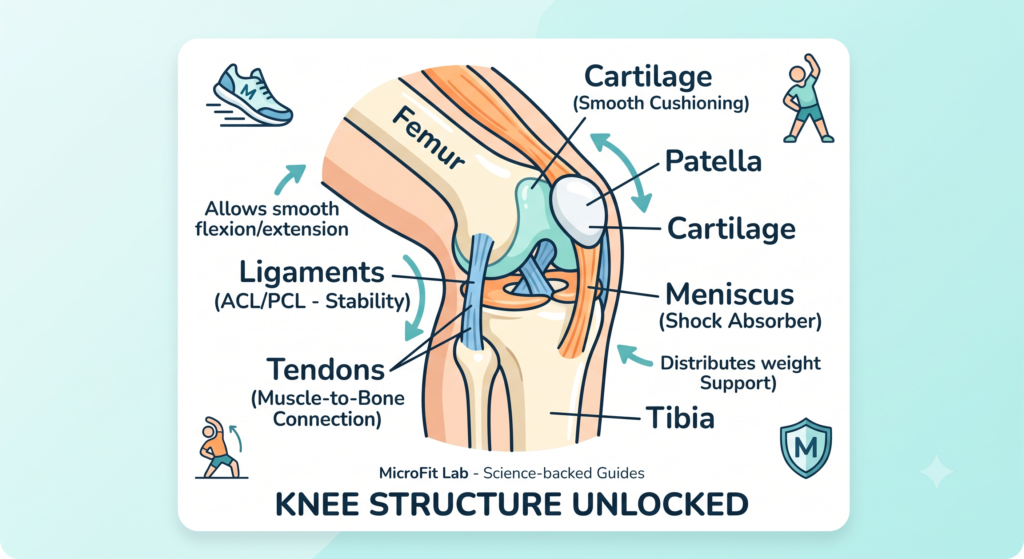
The knee relies on a sophisticated harmony between bones, cartilage, and supportive tissues:
- Articular Cartilage: The smooth, slippery coating on the ends of your bones (
FemurandTibia) that allows them to glide effortlessly without painful friction. - Meniscus: Tough, rubbery C-shaped discs that act as primary “shock absorbers” to distribute body weight evenly.
- Ligaments & Tendons: Strong connective tissues (
ACL,PCL,Patellar Tendon) that act like stabilizing cables, holding the joint securely in place.
2. What Destroys Your Knees? (3 Major Scientific Risk Factors)
According to public health data from the CDC and NHS, knee degeneration usually stems from three preventable factors:
- Prolonged Inactivity (The “Desk Worker Trap”)
- The Science: Joints lack direct blood vessels; they receive nutrients through joint fluid movement. Prolonged sitting starves the cartilage of vital nourishment and weakens the quadriceps, placing double the pressure on the joint once you stand up.
- Excess Load (Weight Factor)
- The Science: NIH research highlights that for every extra pound of body weight gained, your knees experience 3 to 4 pounds of extra pressure with every single step you take.
- Weak Muscle Support
- The Science: Your muscles (especially the quadriceps and hamstrings) are your knees’ first line of defense. Weak surrounding muscles force the joint cartilage to absorb 100% of the impact during daily movements.
3. Actionable Micro-Resets: How to Protect Your Knees Daily
You don’t need heavy equipment or grueling workouts. The NHS and CDC recommend embedding simple, low-impact habits into your daily routine:
- Practice 2-Minute Desk Resets Every Hour
- Seated Leg Extensions: While sitting in your office chair, slowly straighten one leg out parallel to the floor, hold for 5 seconds, and lower it. Repeat 10 times per leg to activate the quadriceps without straining the joint.
- Prioritize Low-Impact Movement
- If your knees occasionally feel sore, swap high-impact jumping and running for low-impact alternatives like cycling, swimming, or brisk walking on flat surfaces.
- Keep Your Stance Balanced
- Avoid standing on one leg for extended periods, sitting cross-legged, or kneeling directly on hard floors without cushioning.
Final Takeaway
Knee protection is not about sudden, intensive rehabilitation; it is about consistent, low-barrier daily care. Incorporating 2-minute Easy Resets during your workday keeps your joints lubricated, your muscles engaged, and your body moving effortlessly for years to come.